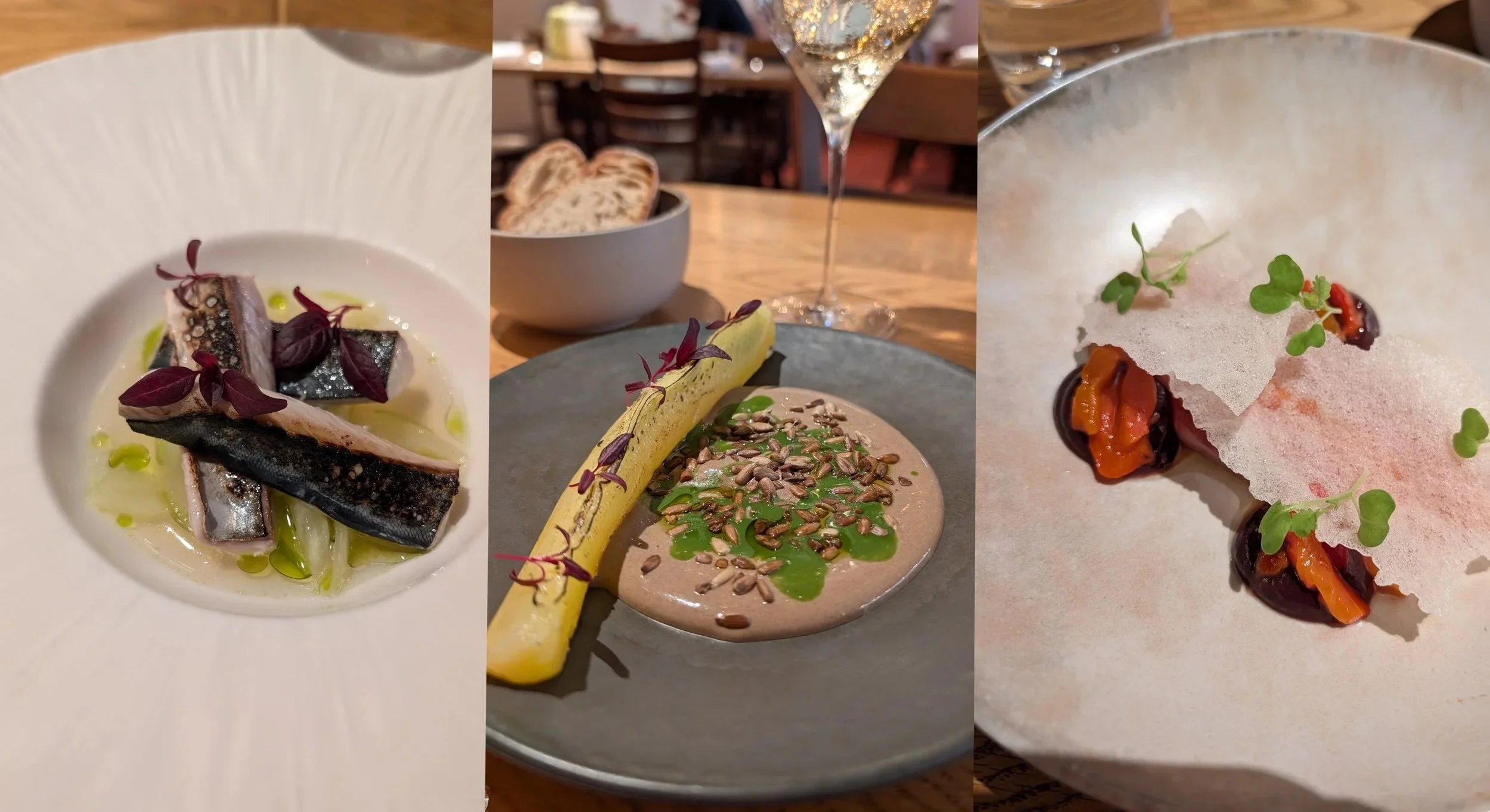
From left: mackerel fish in “escabèche” and fennels, ‘courgette al dente” with tofu, sunflower seeds and black garlic sauce, gravlax trout with bell peppers, cherries and crunchy rice chips
Tucked away on Rue Beautreillis, in the heart of the Marais, SOÉ is the kind of restaurant one might discover almost by accident and leave already knowing it deserves a closer look.
Behind its distinctive blue awning, chef and founder Paul Grillo has created a refined yet welcoming bistronomic restaurant where French culinary roots meet Japanese philosophy, ingredients and techniques. The result is a thoughtful fusion in which contemporary Western cooking and Japanese sensibility coexist naturally, without one overshadowing the other.
SOÉ offers two tasting menus: TAI, a five-course journey, and SOÉ, a seven-course experience. Both reflect a philosophy strongly influenced by the aesthetics of ikebana, where emptiness is considered just as meaningful as fullness. The concept draws on the Japanese tripartite structure of Shin (heaven), Soe (human) and Tai (earth), using asymmetry, connection and balance to create a form of living harmony between the elements.
At the table, this philosophy becomes tangible: the sauces are the soul of the cuisine, bringing together contrasting textures, carefully calibrated acidity and sweetness, and layers of fresh aromatic flavours. A generous pork dish, for example, is paired with a dense, caramelised five-spice sauce, featuring notes such as cinnamon and cardamom. Elsewhere, herbs such as tarragon, dill and parsley, fennel and bright acidic reductions bring freshness and precision, cleansing the palate between richer flavours.
Japanese influence extends naturally into the drinks and desserts: the star here is the Sake, and this is also one of Paul Grillo’s particular passions, and at SOÉ it is far more than a beverage: it becomes part of the culinary language of the restaurant. It appears in cocktails and marinades—fish, for instance, may be prepared with sake, mirin and white vinegar—while wasabi is used with remarkable restraint, elevating rather than dominating the ingredients.
After my dinner, I was curious to discover the person and philosophy behind the restaurant, so I returned the following day to meet Paul Grillo away from the intensity of service.
His approach is remarkably grounded. SOÉ is built around seasonality, local ingredients and carefully selected small producers, allowing the menu to evolve continuously according to the rhythm of nature and the availability of the best products. There is also a strong emphasis on craftsmanship and homemade preparations, from house-made tofu to concentrated broths designed to extract and deepen the natural character of the ingredients.
The philosophy extends to the room itself. SOÉ has the atmosphere of a contemporary neighbourhood bistro: relaxed, intimate and minimalist, with natural wood, plenty of beautiful bottles of Sake on display around the bablue tones and an open kitchen that makes the cooking part of the experience rather than something hidden from view.
What ultimately makes SOÉ particularly compelling is the coherence of the project. The cuisine, the service, the aesthetics and the philosophy all seem to speak the same language. There is precision without stiffness, creativity without unnecessary complication, and a genuine respect for both French produce and Japanese culinary culture.
SOÉ is currently featured in the MICHELIN Guide’s restaurant selection, and it has earned three Écotable distinctions, recognising its commitment to more responsible gastronomy. I would not be surprised to hear one day that SOÉ has earned a MICHELIN star of its own, this is where I place my bet.
